On 29 October 2026, Binance, the world's largest cryptocurrency exchange, disclosed a security incident it estimates at about $6.3 billion. It suspended all deposits and withdrawals. Its preliminary investigation suggests the attacker got in through the work laptop of a single engineer.
You may not own any crypto. This story still matters to you, because the same weakness exists in banks, payment apps and the companies that hold your data.
01What happened, in plain words
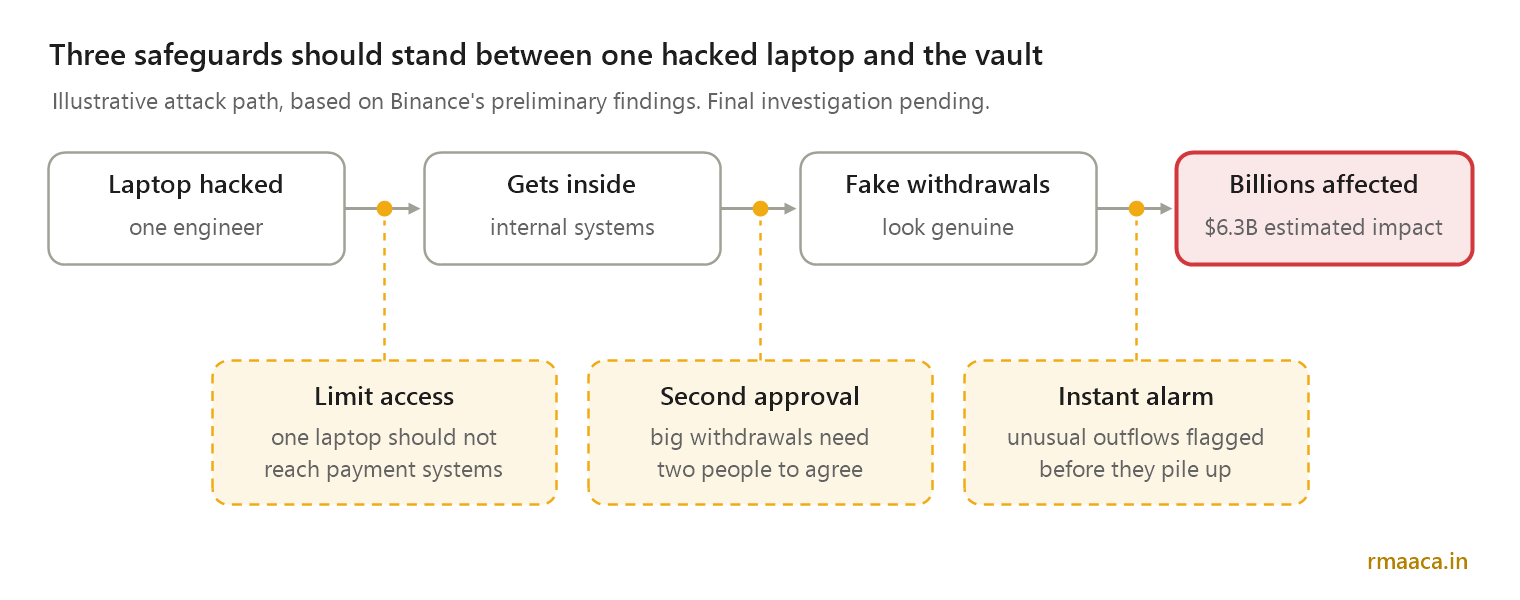
Binance's preliminary account describes a compromised laptop, access to an internal system and unauthorized withdrawals. A full technical report has been promised but not yet published.
- The suspected entry point. Binance's initial investigation suggests an attacker compromised the work laptop of a DevOps engineer, someone who helps run the company's systems.
- Access to internal systems. The attacker allegedly used that access to reach a "service container", a piece of the software that runs the exchange.
- Unauthorized transactions. The attacker submitted withdrawal transactions that moved large amounts of crypto out of Binance-controlled wallets. Binance says it found no evidence that wallet private keys leaked.
- Containment. Binance suspended deposits and withdrawals, revoked the affected address authorization, and brought in law enforcement and blockchain-tracing partners.
- The promise. Binance says it will cover all losses from its SAFU emergency fund and company funds, and that user funds are safe.
Binance's preliminary estimate puts the total impact at about $6.3 billion. Independent blockchain estimates of the assets stolen are a little lower: Chainalysis put it at "at least $5.912 billion", and other trackers at about $5.7 billion. The figures differ because they measure at different times and value the assets differently. The final figure is still under investigation. Either way, it is several times the previous record of $1.5 billion, taken from the exchange Bybit in February 2025.
02Is it real money or just numbers on a screen?
It is real. Actual crypto coins left Binance's wallets, and anyone can see the transfers on the public blockchain.
- The dollar figure is a market value. The hacker took coins such as Bitcoin, Ether and stablecoins, not cash. Binance's "$6.3 billion" is an estimate of what the affected coins were worth, so the figure rises and falls with crypto prices.
- Some of it is stuck. Stablecoins are crypto coins pegged to the US dollar, and the companies that issue them can freeze them. Tether froze about $1.57 billion of its USDT coins and Circle about $800 million of its USDC. The hacker cannot spend those.
- Your exchange balance is a promise. A balance on an exchange is a record of crypto the exchange holds for you, much like a bank deposit. The stolen coins came from Binance's own wallets, so Binance takes the hit first. That is why it can promise to cover users from its reserves.
Binance has promised to cover the losses from its SAFU fund and company funds. That is an important assurance, but it is the company's own statement. Readers should look for its planned updated Proof of Reserves, a public check that it holds enough assets to cover what it owes customers.
03Three controls the investigation must examine
Binance says it has found no evidence that wallet private keys were leaked. If that finding holds, the investigation must establish how the attacker gained the ability to submit unauthorized withdrawals without compromising those keys.
Think of a bank. One clerk's key should not open the main vault, a manager should sign off on a huge cash withdrawal, and the alarm should ring before the money leaves the building. Accountants and auditors call these safeguards "internal controls". We do not yet know which of them failed at Binance, but these are the questions a proper investigation must answer:
| Control area | What auditors call it | Question for investigators |
|---|---|---|
| Access | Access control, segregation of duties | Which systems and privileges could the compromised laptop reach, and should it have been able to? |
| Approval | Independent authorization of high-value transactions | What checks governed these withdrawals, and how were they bypassed or made ineffective? |
| Alarm | Exception reporting, timely escalation | When were the first abnormal withdrawals detected, and how quickly could further transfers be stopped? |
04What went right
The response was fast. As of its 30 October update, Binance reported about $3 billion of the affected assets frozen on-chain. Frozen is not the same as recovered: freezing stops the coins from moving, but the final amount returned and the net loss are still uncertain.
- Binance hit the brakes. Pausing all deposits and withdrawals limited further losses. It is inconvenient for users, but it is the right move in an emergency.
- Partners froze coins. Reuters reported that Tether froze nearly $1.57 billion, Circle more than $800 million and Ripple about $200 million linked to the incident.
- A public commitment. Binance promised to cover all user losses, which helps prevent a panic rush to withdraw.
- The trail is public. Every blockchain transfer is visible, so investigators can follow the money as it moves.
05What this means for you
The biggest danger to ordinary people now is not the hack itself but the scams that follow it.
- Expect fake "Binance Security" calls and messages. Scammers use the news to sound believable. Some now use AI-cloned voices and deepfake videos of company leaders. Binance will never ask for your password, OTP, 2FA code or seed phrase, or ask you to install a screen-sharing app.
- Ignore "refund" and "compensation" links. Any compensation will appear inside the official app or website. Do not click links sent by SMS, WhatsApp, Telegram or email.
- Get news only from official channels. Use the Binance app, binance.com, and Binance's verified social media accounts.
- Do not keep all your eggs in one basket. Any platform can be hacked. Spreading savings across different places limits the damage if one fails.
- Protect your own devices. This hack started with one laptop. Keep your phone and computer updated, use strong unique passwords, and turn on app-based two-factor authentication.
- If you are cheated, report it fast. In India, call the cybercrime helpline 1930 or file a complaint at cybercrime.gov.in.
06Speed cuts both ways
When money moves faster, fraud moves faster too, and often faster than the defense. The attacker plans the moment of attack, while the company has to notice, confirm and decide. Machines move money in seconds, but stopping a whole system usually needs a human decision. Losses pile up in that gap.
Speed also removes the chance to undo. Crypto transfers cannot be reversed, and instant bank payments such as UPI and IMPS can be withdrawn or moved on within minutes.
The answer is deliberate friction where the risk is high:
- Automatic holds, not just alerts. Large or unusual transfers pause until a second person approves them, the "maker-checker" principle banks use.
- Cooling-off periods. A new payee, new device or password change triggers a wait before big transfers.
- Limits. Daily or hourly caps mean even a successful attack cannot empty everything at once.
- Automated first response. If attacks run at machine speed, the first defense must be automatic, with people reviewing afterwards.
The same rule protects individuals. Scammers rely on urgency: "act now or your account will be blocked." Slow down, hang up, and check through the official app before you share an OTP or send money.
07The bottom line: security is a governance responsibility
The lesson is not simply that laptops can be hacked. Access to critical systems, approval of transactions and detection of trouble must work together. No compromised employee device should become a route to catastrophic loss, and no organization should discover a breach only after the damage is done.
For business owners, directors and finance teams, these are questions of internal control, risk management and accountability, not just IT. Ask three questions of your own organization:
It is proven when it prevents, detects and contains a real attack.
Reviewing your Internal Controls?
We help businesses test access, authorisation and monitoring controls before an incident does it for them, grounded in 25+ years of practice.
Schedule a Consultation