Jio Platforms opens India's largest-ever IPO on 21 October 2026, ahead of Hyundai Motor India's ₹27,870 crore issue in 2024 and LIC's roughly ₹21,000 crore in 2022.
Read the headline again. Then read the prospectus.
The headline celebrates the money. The more revealing number is the ownership. At a valuation of about ₹10.3 lakh crore, Jio is issuing 27 crore new shares, roughly 2.9% of its post-issue equity.
The size of the cheque tells us how much capital is being raised. The percentage tells us how much ownership is being distributed. They are two different measures, and the headline celebrates only one.
01The numbers at a glance
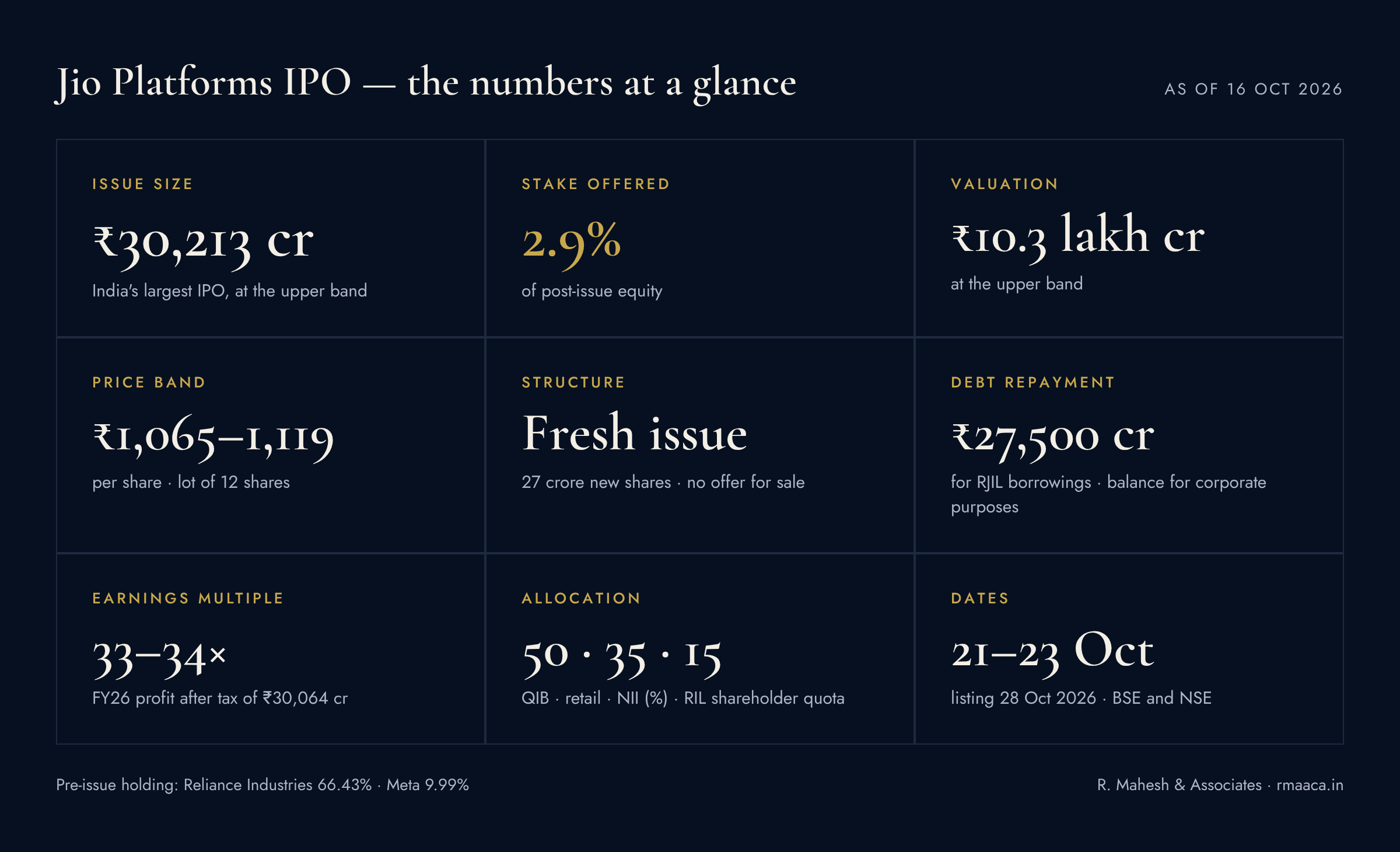
02Five things investors should notice
1. The valuation does the heavy lifting.
At about ₹10.3 lakh crore, a 2.9% stake is worth more than ₹30,000 crore. The record reflects the scale of the company as much as the scale of the offering.
2. Minimum dilution, maximum headline.
The issue is historic in value. The share of ownership entering the public market is modest. Over 97% of the equity stays where it was before the issue.
3. Regulation made this structure possible.
The recast Securities Contracts (Regulation) Rules let the largest issuers list with lower initial dilution. For a post-issue market cap above ₹5 lakh crore, the minimum offer is ₹15,000 crore and at least 1% of market cap, subject to a minimum dilution of 2.5%. On our reading, at Jio's valuation the 2.5% test is the one that binds, about ₹25,750 crore, and Jio's offer sits just above it.
The older rule, ₹5,000 crore plus 5% of market cap, would have forced a far larger issue. Jio is the first landmark test of the new framework. The open question is whether the balance between listing flexibility and meaningful public ownership is right.
4. Fresh capital is not the same as growth capital.
The issue is entirely fresh equity. No existing shareholder sells in this transaction. But up to ₹27,500 crore is earmarked to repay or prepay borrowings of Reliance Jio Infocomm (RJIL), the operating subsidiary, with the balance for general corporate purposes.
Jio Platforms' net debt stood at ₹27,579 crore in March 2026, down from ₹45,273 crore a year earlier. In effect, the public is funding the near-elimination of net debt. That strengthens the balance sheet. It is not capital deployed into expansion, and investors should price it accordingly.
5. The public float story does not end at listing.
Jio must still reach 25% public shareholding. Issuers above ₹1 lakh crore get an extended timeline that depends on the float at listing, up to ten years in some cases. Expect further dilution and follow-on offerings over time. Today's ownership picture is the starting point, not the settled one.
03The question behind the record
None of this makes Jio a bad IPO. A small float is not proof of poor governance, and the structure is fully disclosed and compliant. But a record IPO and broad public ownership are two different things.
At 33–34 times FY26 earnings, the public pays a growth multiple for a minority stake with little say in how the company is run. The real test is not how much Jio raises on day one. It is whether the listing creates meaningful public participation, adequate liquidity and accountability, without mistaking a record valuation for a guarantee of returns.
Weighing an IPO Application?
We help investors read offer documents, understand capital gains on listing and exit, and plan their portfolios — grounded in 25+ years of practice.
Schedule a Consultation