Satellite broadband is India's next connectivity frontier. But the investment question is not simply who has the most satellites or subscribers. It is who can turn connectivity into sustainable profits after accounting for capital expenditure, technology costs and competition.
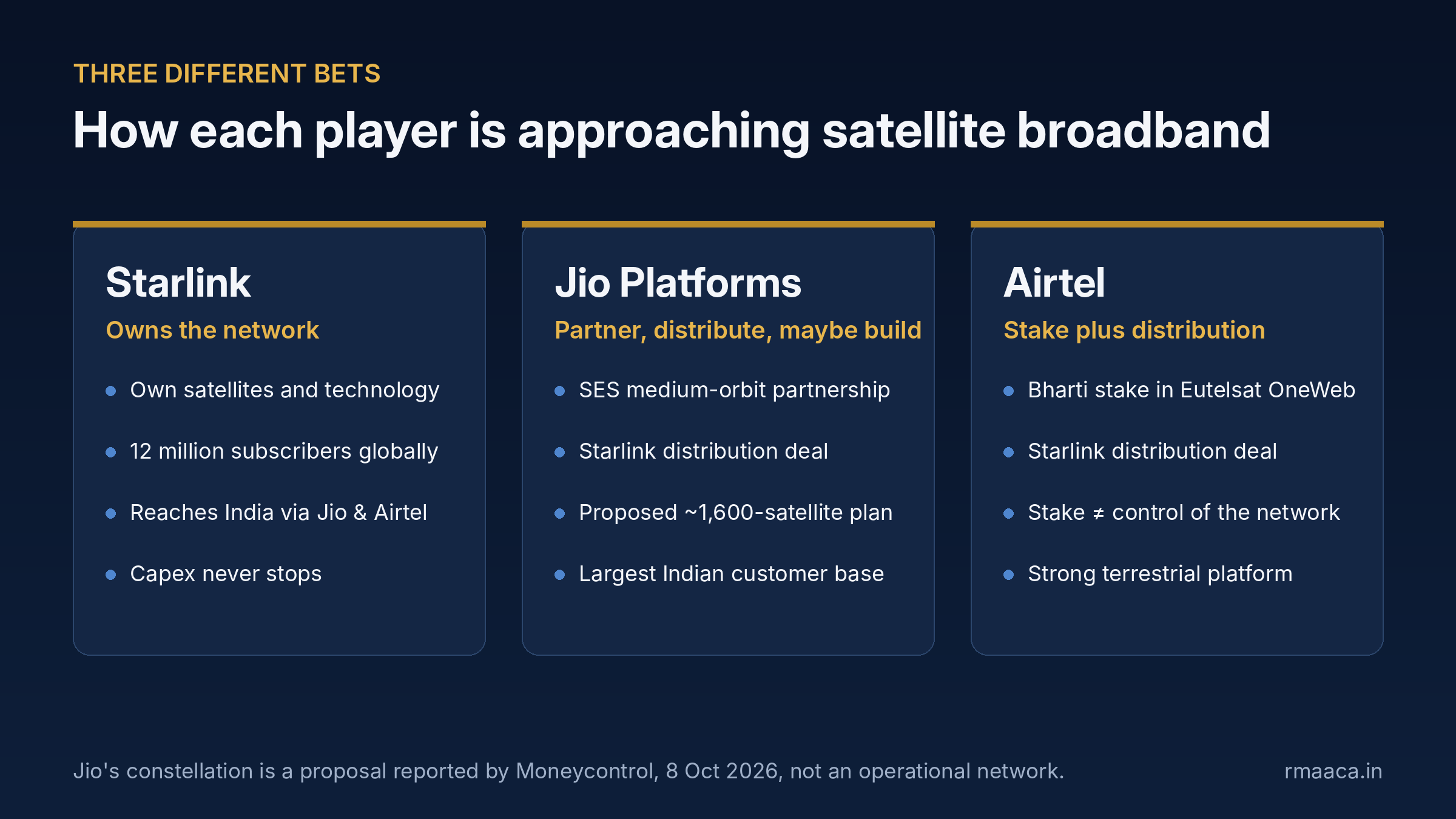
01Starlink: owning the technology and the network
Starlink, SpaceX's satellite internet business, had 12 million subscribers at the end of Q2 2026.
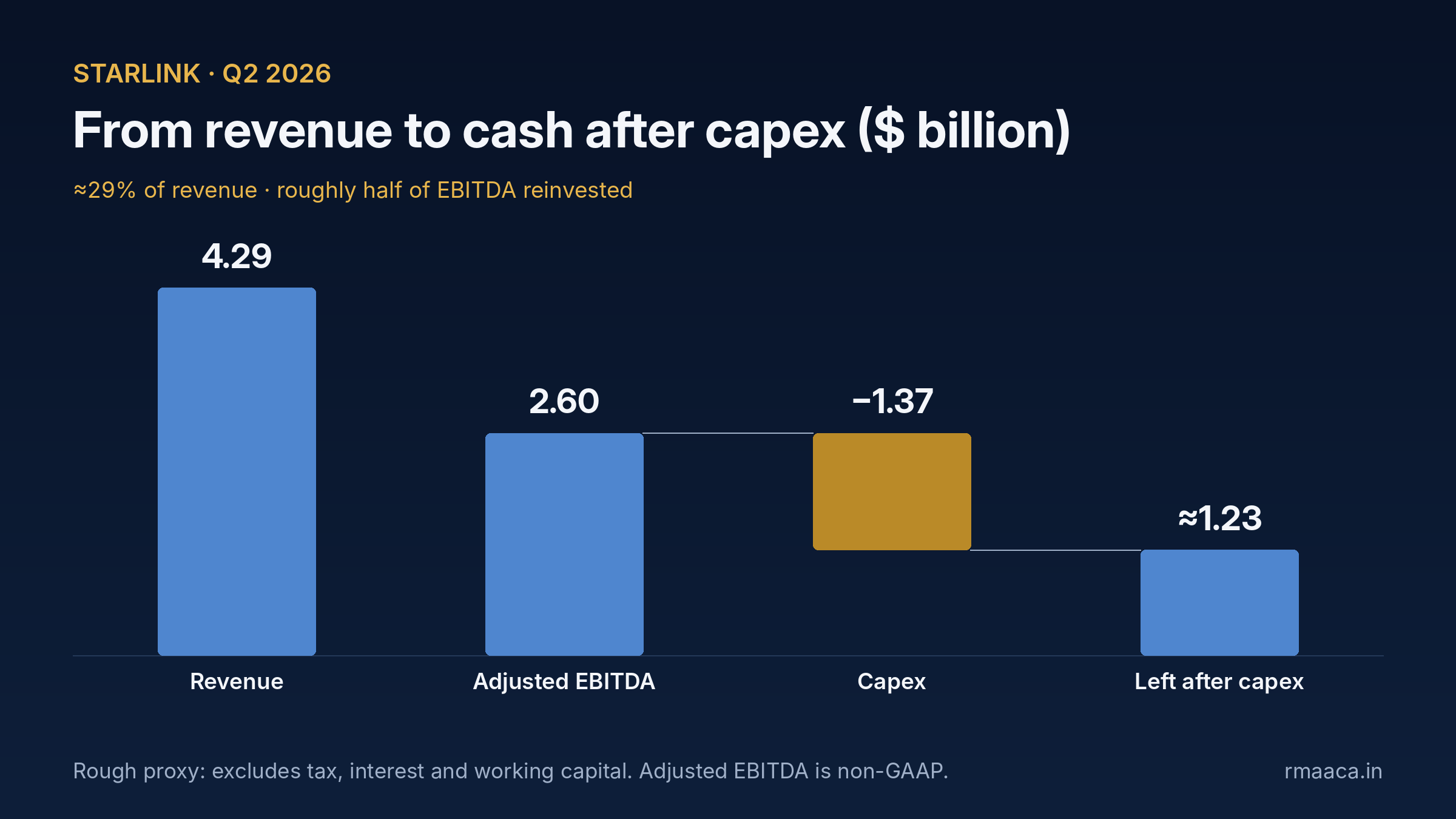
For the quarter ended 30 June 2026, Starlink's connectivity revenue was $4.291 billion and its adjusted EBITDA was $2.597 billion, giving it an adjusted EBITDA margin of approximately 60.5%.
Annualising the quarterly revenue produces a run rate of about $17.2 billion. This is an extrapolation, not reported full-year revenue.
Starlink's advantage is control over its satellite network, technology and customer proposition. Its challenge is equally clear: satellites require replacement, capacity must expand with demand, and the business must continually invest in next-generation infrastructure.
The capital expenditure figures are particularly revealing. Starlink's connectivity segment reported $1.367 billion in capital expenditure in Q2 2026. Adjusted EBITDA of $2.597 billion is impressive, but it is not the same as free cash flow after capital investment.
Deducting that capital expenditure leaves roughly $1.23 billion, or about 29% of revenue. In other words, close to half of the quarter's adjusted EBITDA went straight back into the network. This is only a rough proxy, as it excludes tax, interest and working-capital movements, but it shows why the free-cash-flow test matters.
02Jio: scale, partnerships and a potential satellite ambition
Jio Platforms reported FY26 revenue from operations of ₹1,46,885 crore and EBITDA of ₹76,255 crore, implying an EBITDA margin of 51.9%.
As at 31 March 2026, Reliance Jio Infocomm served 524.4 million customers in India.
Jio has pursued satellite connectivity through SES's medium-Earth-orbit infrastructure and a distribution agreement with Starlink. Separately, Moneycontrol reported on 8 October 2026 that Jio was considering a proposed constellation of approximately 1,600 low-Earth-orbit satellites and 23 ground stations.
These are three different strategic choices: using a partner's network, distributing another provider's service, and potentially developing a constellation of its own.
Jio's enormous customer base gives it a potential distribution advantage. But the strategic question is whether it can turn that advantage into a satellite business with attractive returns without committing uneconomic amounts of capital.
03Airtel: a strategic stake in satellite connectivity
Airtel combines its terrestrial telecom business with a distribution relationship with Starlink and the Bharti Group's stake in Eutelsat OneWeb.
Its latest available quarterly results, for Q1 FY27 ended 30 June 2026, show:
- India revenue: ₹41,214 crore
- India EBITDA: ₹24,781 crore
- India EBITDA margin: 60.1%
- India EBITDA after leases (EBITDAaL): ₹22,788 crore
- India EBITDAaL margin: 55.3%
Airtel's India customer base was approximately 491.9 million, according to its Q1 FY27 results.
The distinction between EBITDA and EBITDAaL matters. EBITDAaL accounts for lease costs and offers a useful additional perspective when evaluating telecom operators that rely on leased infrastructure.
These figures describe Airtel India's overall business, not satellite broadband specifically.
Airtel's position combines its existing telecom distribution network with exposure to a satellite operator through the Bharti Group's investment. However, a stake in a satellite operator is not the same as owning and controlling the entire satellite business, and it does not guarantee attractive returns.
04The financial comparison
| Metric | Starlink | Jio Platforms | Airtel India |
|---|---|---|---|
| Reporting period | Q2 2026 | FY26 | Q1 FY27 |
| Revenue | $4.291 billion (quarter) | ₹1,46,885 crore (year) | ₹41,214 crore (quarter) |
| EBITDA | $2.597 billion (quarter) | ₹76,255 crore (year) | ₹24,781 crore (quarter) |
| EBITDA margin | 60.5% | 51.9% | 60.1% |
| EBITDAaL margin | — | — | 55.3% |
| Customer base | 12 million subscribers (global) | 524.4 million (31 Mar 2026) | About 491.9 million |
The periods differ: Starlink and Airtel figures are quarterly, while Jio's figures are annual. Their customer definitions and business boundaries also differ. EBITDAaL is shown only for Airtel, which reports it. These are contextual indicators, not a like-for-like valuation comparison.
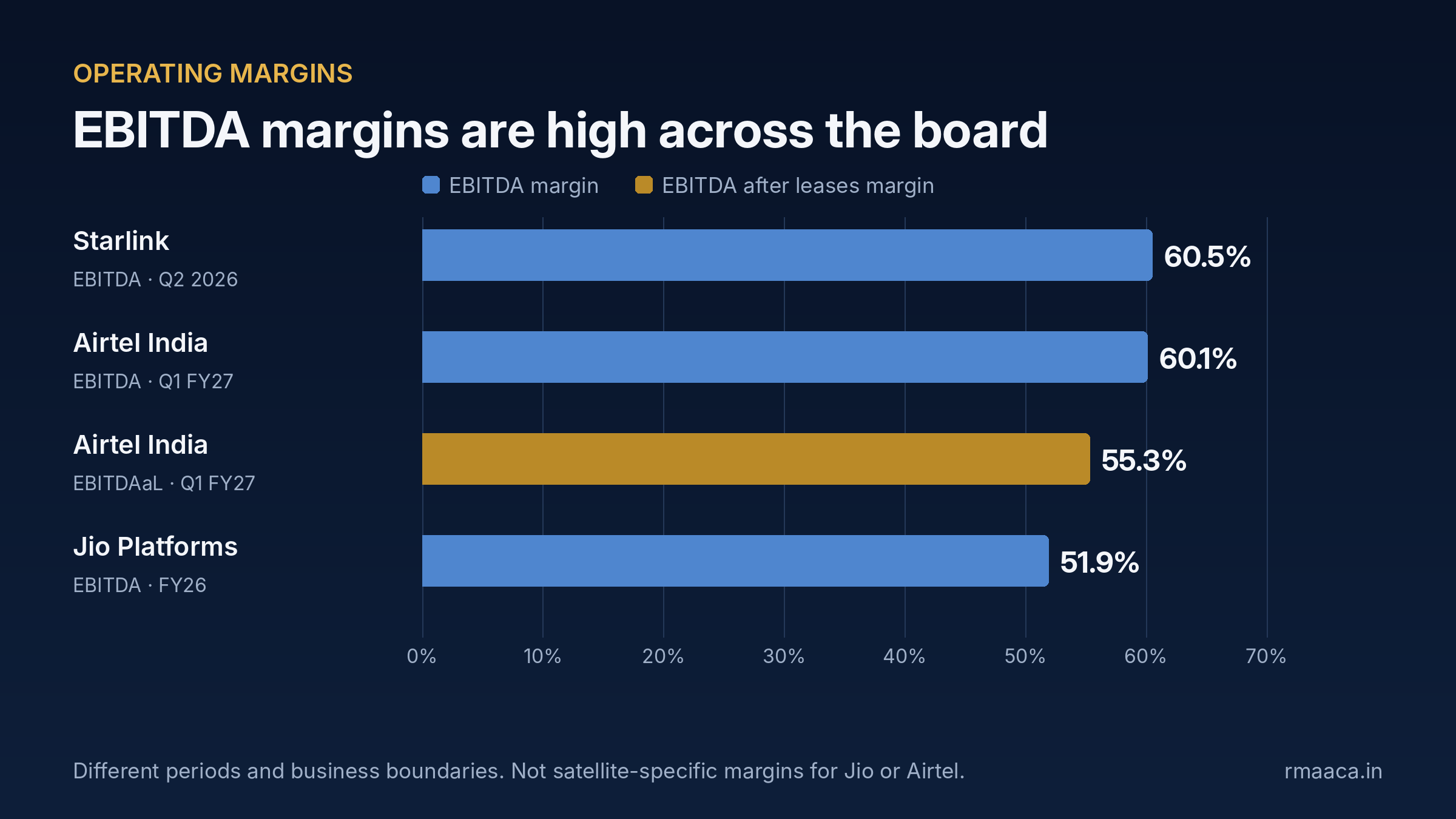
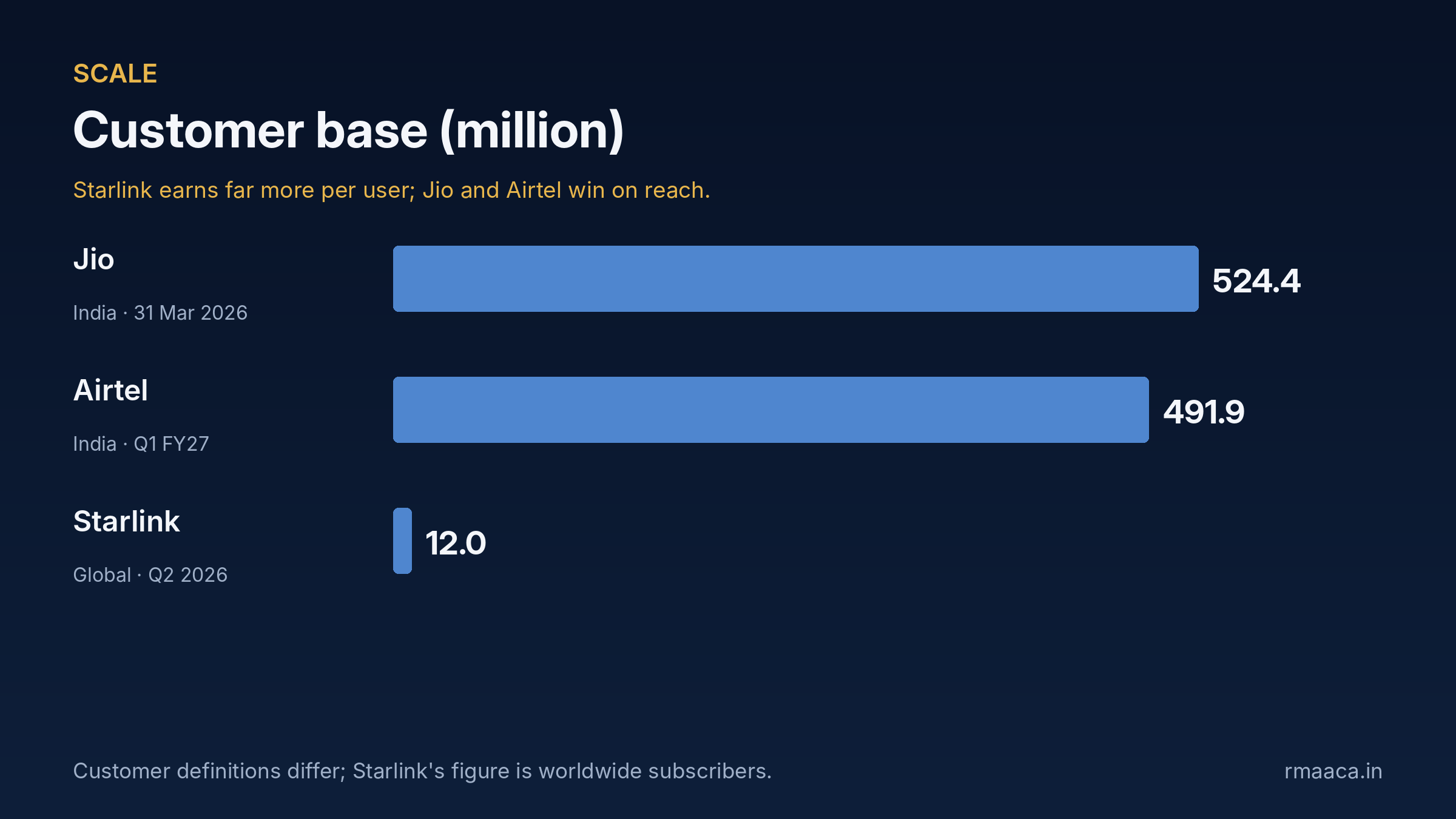
Most importantly, none of these figures establishes the profitability of Jio's or Airtel's satellite services. Their satellite-specific revenue, EBITDA and capital expenditure are not separately established by the numbers above.
The opportunity is real, but it is still conditional.
As of 17 October 2026, reporting indicated that Starlink, Jio and OneWeb still faced outstanding spectrum-allocation requirements and regulatory clearances before commencing commercial satellite broadband services in India.
Satellite capacity, security requirements, spectrum costs, local infrastructure and commercial authorisations will all influence when operators can launch and what their economics will look like.
05EBITDA is not the final answer
Starlink's bet is to own and expand a global satellite network. Jio's strategy combines a huge domestic customer base with partnerships and potential direct satellite investment. Airtel combines terrestrial telecom scale with exposure to satellite connectivity through distribution and ownership.
Each strategy has a different balance of capital requirements, technology risk and potential returns. For investors, three questions matter.
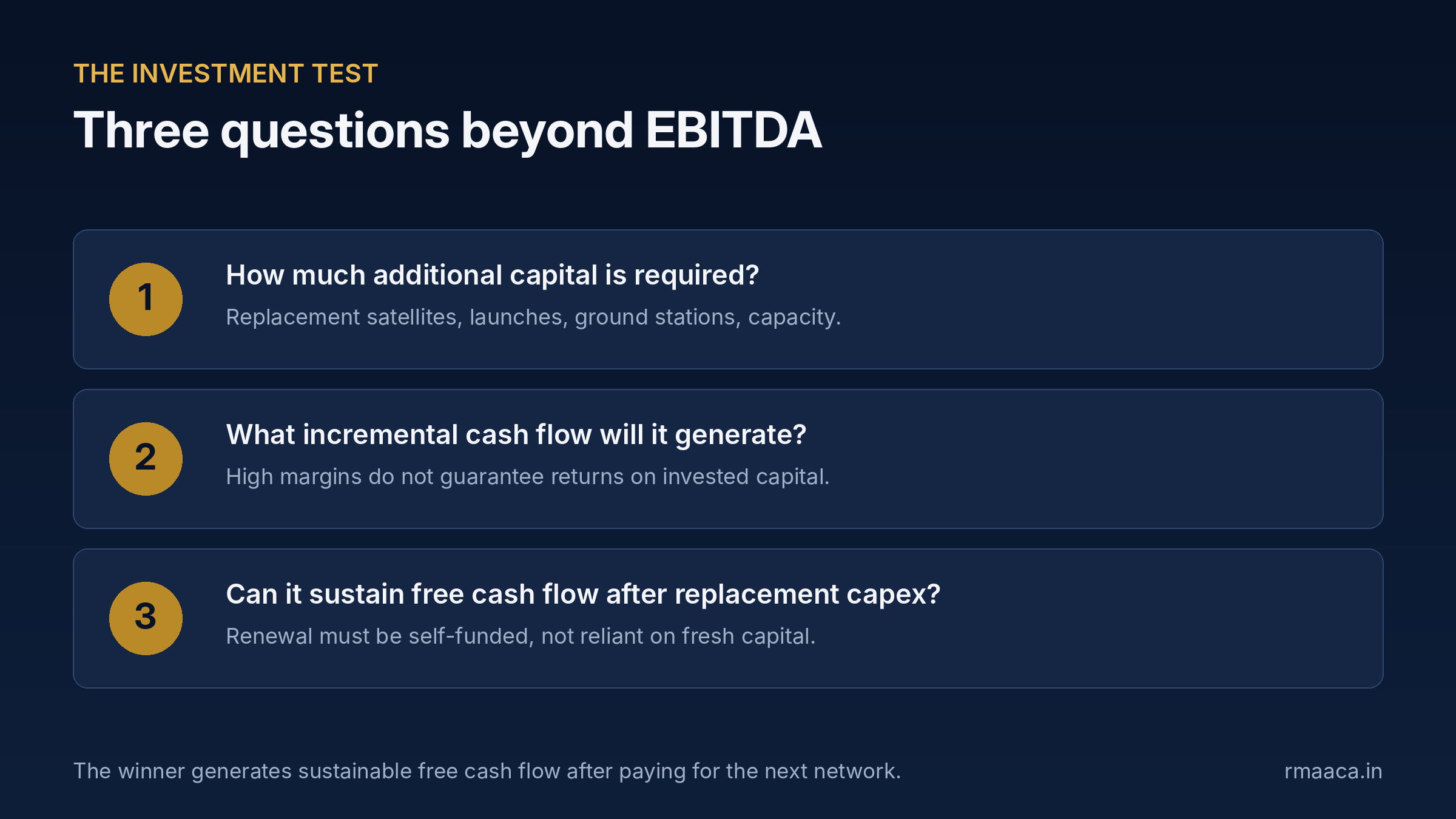
1. How much additional capital is required?
Satellite replacement, launches, ground stations and capacity expansion can absorb substantial cash.
2. What incremental cash flow will the investment generate?
Revenue growth and high EBITDA margins do not guarantee attractive returns on invested capital.
3. Can the business sustain free cash flow after replacement capital expenditure?
A network that must constantly be renewed needs to fund that renewal without relying indefinitely on fresh external capital.
Satellite broadband could become a valuable market in India, particularly for remote communities, enterprises, transport and locations underserved by terrestrial networks. But its commercial success will depend on affordability, regulatory access, utilisation and disciplined capital allocation.
Evaluating a Telecom Investment?
We help investors read results and offer documents, understand capital gains on entry and exit, and plan their portfolios — grounded in 25+ years of practice.
Schedule a Consultation