| Company | Coforge Limited, a listed IT services company |
| The documents | Coforge's disclosures to the stock exchanges dated 9 September and 11 September 2026 |
| The vote | At the AGM on 24 August 2026, shareholders voted on Bhatt's re-appointment as independent director and chairperson for a second five-year term (1 May 2027 to 30 April 2032). As reported, the special resolution received about 65% against the 75% required, and was not passed |
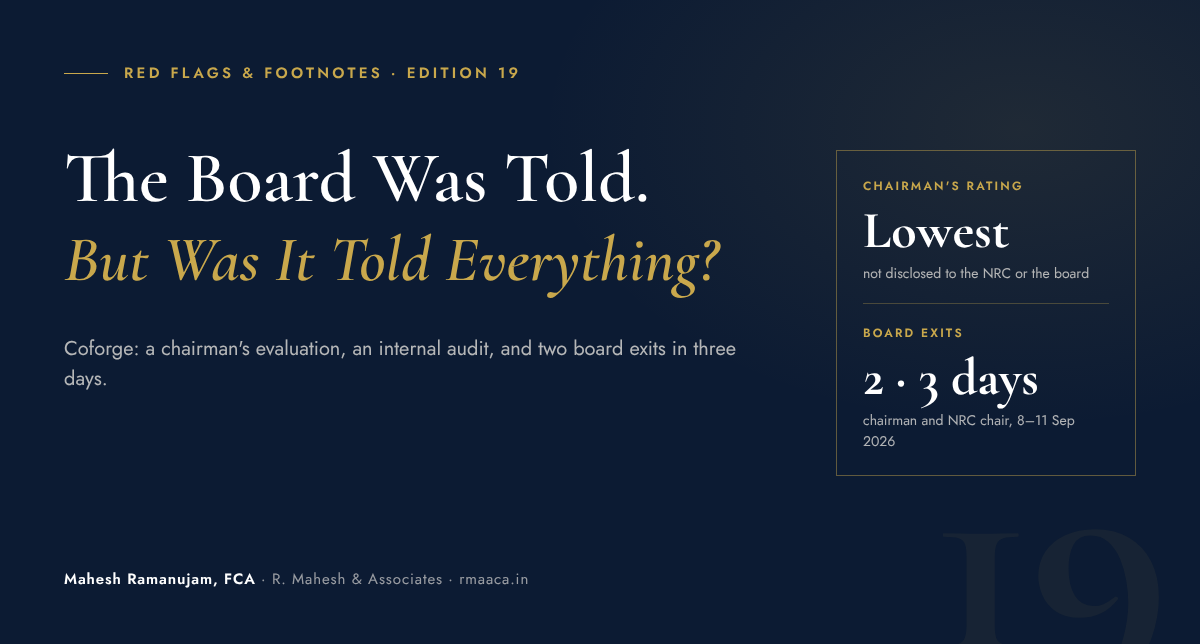
| First exit | O. P. Bhatt, independent director and chairperson, resigned by email dated 8 September 2026, with effect from that day. The company disclosed it on 9 September, after its internal auditor raised concerns about how the Board Evaluation Report had been handled and presented |
| The finding | As disclosed by the company: the evaluation reports from the external survey agency were available only to Bhatt and D. K. Singh, not to the other directors; and the presentation to the NRC and the board did not disclose that the Chairman's performance category had received the lowest rating |
| Second exit | D. K. Singh, independent director and chair of the Nomination and Remuneration Committee (NRC), resigned on 11 September (email dated 10 September), citing "differences and tension" between independent and executive directors |
| The company's position | Coforge called Singh's allegation "unfounded" and "an afterthought", and stated that the matter does not relate to its financial statements or financial reporting |
| Board changes | Beth Boucher designated NRC chairperson; Vivek Sharma appointed interim chair. On 28 September, Coforge announced Akhil Kumar Gupta as non-executive independent director and chairperson for five years from 29 September 2026 |
| Status | Company disclosures only. No regulatory order or proceeding on this matter was identified in the sources reviewed |
Every listed company in India runs an annual board evaluation. Most investors treat it as a box that gets ticked. Coforge's disclosures show why it is more than that: an evaluation is a channel through which uncomfortable information is supposed to reach the people responsible for acting on it.
If the channel narrows before the information reaches the full board, the process can exist on paper and still fail at the one thing it is for.
The question behind the headline
Earlier editions have followed money: where it went, who approved it, and whether the board should have asked why it took a detour. This edition follows something less visible: information.
No rupee figure is in dispute here. Coforge has stated that the matter does not relate to its financial statements or financial reporting. What the company's disclosures describe instead is a board process—the annual evaluation of the board, its committees and its chair—whose most uncomfortable finding did not reach the board.
First question: what did the internal audit find?
According to Coforge's 11 September disclosure, the internal auditor reviewed three sets of evidence: video recordings of the relevant board and NRC meetings, the evaluation reports obtained from the external survey agency, and the minutes of those meetings.
Two findings follow from the company's account. First, the survey agency's reports were available only to Bhatt and to Singh, the NRC chair. They were not circulated to the other directors, including the independent directors. Second, the presentation of the findings to the NRC and the board did not cover all relevant aspects. In particular, it did not disclose that the Chairman's performance category had received the lowest rating in the evaluation.
The method matters as much as the finding. A policy, a survey agency and a signed report would each have shown that an evaluation took place. Only a comparison of the source reports against what was actually said in the meetings could show what had been left out. By the company's account, that is the comparison the internal auditor made.
A report that exists but does not reach the board satisfies the form of governance, not its purpose.
Why the rating mattered
There was no fraud here, and no misstatement. But the withheld finding was not a matter of etiquette either. A board evaluation is not a report card filed away. For an independent director, it is the document the law ties to whether that director stays.
Schedule IV of the Companies Act, 2013 sets out the evaluation mechanism for independent directors: on the basis of the report of performance evaluation, it shall be determined whether to extend or continue the term of appointment of the independent director. SEBI's Listing Regulations add a second channel. Independent directors are to meet separately to review the performance of the chairperson, and to assess the quality, quantity and timeliness of the flow of information between management and the board.
Bhatt was an independent director as well as the chairperson. At Coforge's AGM on 24 August 2026, shareholders voted on his re-appointment for a second five-year term, from May 2027 to April 2032. As reported, the special resolution needed 75% and received about 65%, with Advent International among those voting against. Business Standard reported that board members had flagged concerns about Bhatt before the extension was rejected.
The finding that did not reach the NRC or the board was the lowest rating for the chairman's own performance category. That is the input the evaluation framework connects to the decision on extending an independent director's term, and Bhatt's extension was the decision before shareholders that August.
The disclosures do not establish what the NRC or the board would have done had they seen the rating, or how the evaluation was used in proposing the resolution. They establish that the finding most relevant to that decision was not presented to them.
Second question: who controlled the information?
By the company's account, the full reports sat with two people: the chairman, whose own performance category had received the lowest rating, and the chair of the committee responsible for director evaluation. Everyone else on the board depended on what those two chose to present.
The problem is structural before it is personal. Independent directors are expected to exercise objective judgement, including about the chair. They cannot do that if someone else decides which parts of the evaluation they see. A system that lets the person being evaluated sit between the evaluation and the board depends entirely on that person's restraint.
This does not mean every survey response must be circulated verbatim. Evaluations rely on candour, and candour relies on confidentiality. But confidentiality protects the people giving the ratings. It is not a reason to withhold the result from the directors responsible for acting on it. The question an earlier edition asked about money—who really controls the business—applies equally to information.
Third question: two accounts of one boardroom
Singh's resignation introduced a second account. In his email of 10 September, he cited "differences and tension" between independent and executive directors, linked to the board's shift from a private-equity-led structure to a more independent one, and said "the current circumstances may make it increasingly difficult" for him to fulfil his duties as an independent director.
Coforge rejected that explanation. It called the allegation "unfounded" and said it "more pertinently appears as an afterthought", stating that the board had worked with close cooperation and unanimity since 2024. The company placed Singh's resignation in the context of the internal auditor's concerns about the evaluation exercise.
The disclosures do not resolve the disagreement, and this edition does not attempt to. What they do establish, on the company's own record, is a sequence: shareholders declined to extend the chairman's term; an internal audit raised concerns about how evaluation findings were handled; the chairman resigned; and three days later, so did the director who chaired the committee responsible for the evaluation.
Fourth question: how does a rating affect what the company is worth?
Nothing in this case touches the income statement. Coforge said so directly. Its 9 September disclosure stated that the board evaluation exercise does not relate to its financial statements, financial reporting or any financial matters, and that the matter has no bearing on its operations, business performance or guidance.
The market took a different view of the same day's news. As reported, Coforge's shares fell as much as 8.7% in early trade on 9 September and closed 5.2% lower at ₹1,846.90 on the BSE. Revenue, margins and the order book had not changed overnight. What had changed was investors' confidence in the board that oversees them.
That gap is the lesson. A company's value is not only its expected cash flows. It is also the confidence investors place in the people overseeing those cash flows. A governance event does not change this quarter's earnings. It changes the discount investors apply to every future quarter. Four channels connect a withheld evaluation finding to value:
- Leadership continuity. The chairman and the NRC chair left within three days, and the board ran under an interim chair until a new chairperson was announced on 28 September. Investors price the risk of a board in transition.
- Credibility of oversight. If one evaluation finding could stop short of the board, investors are entitled to ask what else reaches it in filtered form. Oversight is valued because it is assumed to be complete. Once that assumption is questioned, it is harder to take on trust.
- Shareholder alignment. A special resolution on the chair's re-appointment failed at the AGM, with a large shareholder reportedly voting against. A visible split between a board proposal and a large shareholder is itself information about future decisions.
- Distraction cost. Internal audits, resignation disputes and a chair search consume board time. That cost does not appear as a line item, but it is borne by the company.
There is a boundary here too. A single day's price move cannot be attributed entirely to this matter, and it is not a measure of permanent value lost. The board's response over the following weeks, including the speed of the new chair's appointment, is part of what the market will weigh. The point is narrower: governance is not a soft factor outside valuation. It is priced, and in this case, on the day of disclosure, it was priced before anyone had changed a single number.
The numbers did not change. The confidence did, and confidence is part of the price.
What this case is not
Coforge has stated that the matter does not relate to its financial statements or financial reporting. Nothing in its disclosures alleges fraud, a misstatement or a statutory audit failure, and the internal auditor's observations are not a regulatory finding or a final adjudication of anyone's conduct. This is a case about the integrity of a governance process. That is serious enough without overstating what the evidence shows.
The timeline
If you were on this board…
Would you ask:
- Who receives the external survey agency's report first—and does anyone receive it before the full board?
- Does the NRC see the agency's findings directly, or only a summary prepared by someone being evaluated?
- Does any director whose own performance is being assessed control what the board is told about it?
- When the board recommends an independent director's re-appointment, has it seen that director's evaluation findings, including the unfavourable ones?
- Would our minutes show what material findings were presented—and what was left out?
- Has internal audit ever been asked to review the evaluation process itself, not just the existence of a report?
- If an evaluation finding is uncomfortable for the chair, who is responsible for putting it on the agenda?
- As an investor: when the company says a governance event has "no bearing" on the business, what would make you discount the board that said it?
A board evaluation is only as independent as the person who controls who reads it.
The real lesson
The case has no fraud in it, and that is what makes it instructive. The evaluation finding was the input to a real decision about who should lead the board, and it did not reach the people taking that decision. The market's reaction showed that investors treat the integrity of that process as part of what they are paying for.
Coforge had what good governance is supposed to look like on paper: independent directors, an NRC, an external evaluation agency and an internal auditor. On the company's own account, the structures existed. What narrowed was the path the findings took to the board.
The safeguards follow directly. The NRC and the board should receive the substantive evaluation findings, with confidentiality protecting individual raters rather than the result. Board papers and minutes should make it possible to establish what was presented and what followed. And the process should be designed so that no director whose performance is being assessed controls what the board learns about it—with independent review, such as the one internal audit performed here, built in rather than triggered after the fact.
The lesson for anyone who audits the auditors is the same one the internal auditor applied: do not test whether a document exists. Test whether what it says reached the people it was meant for.
Final Footnote
This edition relies on Coforge's disclosures to the stock exchanges dated 9 and 11 September 2026 and on published reporting of those disclosures. Statements about the internal audit's method and findings are the company's account; Singh's reasons are his own, as stated in his resignation email; and the company's rebuttal is its position. This edition does not adjudicate between them, does not allege fraud or financial misstatement, and does not suggest that the internal auditor's observations amount to a finding of personal wrongdoing. The AGM vote figures and Advent's vote are as reported in the press, not taken from the voting results filing. Any subsequent disclosure, regulatory action or board decision should be checked before relying on this edition at a later date.
Every filing answers a question.
Sometimes the footnote is who was allowed to read the report.
Next edition: another file, another number, another question nobody should ignore.
Coforge Limited — exchange disclosure dated 9 September 2026: resignation of O. P. Bhatt (email dated 8 September) and internal-audit concerns (primary source, as reproduced) ·
Coforge Limited — outcome of board meeting, 11 September 2026: resignation of D. K. Singh (email dated 10 September), the internal audit's review, the company's response and board changes (primary source, as reproduced) ·
Coforge Limited — further exchange disclosure: statement that the matter does not relate to financial statements or financial reporting ·
NSE corporate announcements (search: COFORGE) ·
Business Standard — Coforge NRC chair resigns citing differences, tension between directors, 11 September 2026 ·
Outlook Business — company says no bearing on business; shares close 5.2% lower, 9 September 2026 ·
Business Standard — Coforge board flagged concerns over OP Bhatt before extension was rejected ·
Business Today — AGM vote on Bhatt's continuation, 10 September 2026 ·
Coforge appoints Akhil Kumar Gupta as chairperson, 29 September 2026 ·
Companies Act, 2013, Schedule IV (Code for Independent Directors), evaluation mechanism · SEBI (LODR) Regulations, 2015, Regulation 25 (separate meeting of independent directors) ·
Moneylife — Coforge shares fall up to 8.7% in early trade after chairman's exit.
Status checked against sources available as of 26 October 2026.
Red Flags & Footnotes is written by Mahesh Ramanujam, FCA, DISA(ICAI), ICAI Member No. 206817, proprietor of R. Mahesh & Associates, Chartered Accountants, Egmore, Chennai – 600 008. © 2026 R. Mahesh & Associates. All rights reserved.