| Company | EKI Energy Services Limited, a carbon-credit developer and trader, listed on the BSE SME platform in April 2021 and migrated to the main board in July 2022 |
| The document | SEBI final order dated 30 October 2026 (Ref. QUA/MNICFID/CFID-SEC6/32818/2026-27), passed by Quasi-Judicial Authority N. Murugan under Sections 11, 11B and related provisions of the SEBI Act |
| Investigation period | FY 2020–21 to FY 2022–23 |
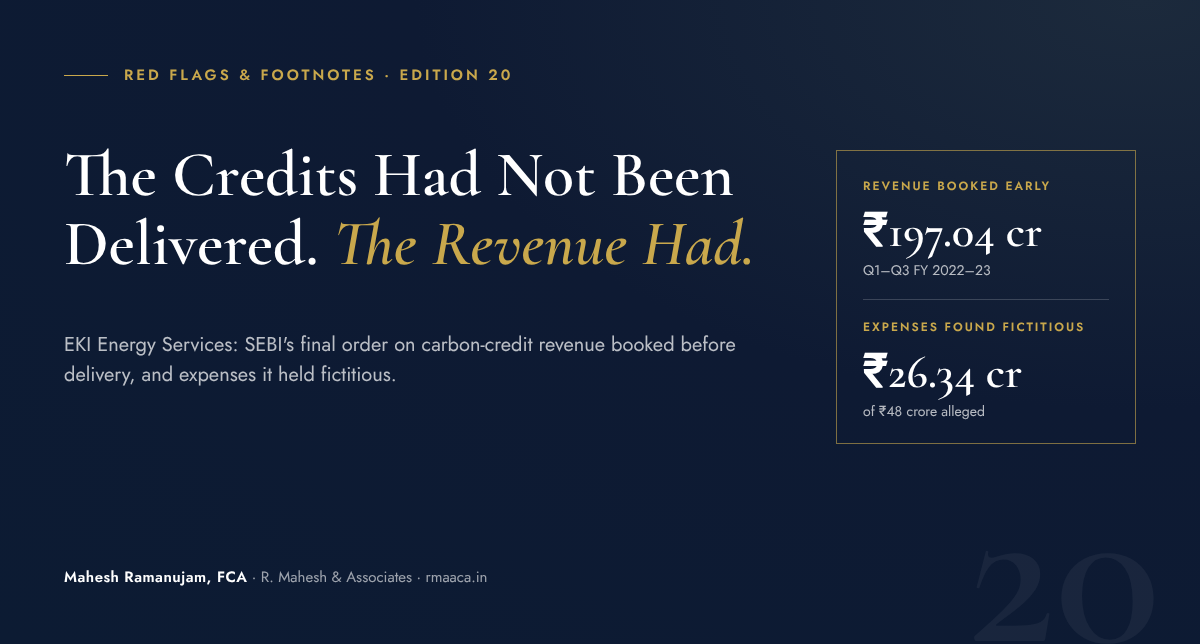
| Finding 1 — revenue | ₹197.04 crore recognised prematurely across Q1, Q2 and Q3 of FY 2022–23, held to be reckless financial misrepresentation |
| Finding 2 — expenses | ₹26.34 crore of commission, consultancy and professional expenses in FY 2021–22 and FY 2022–23 found unsupported by sufficient evidence that the services were rendered, and held to be fictitious; the payments against them a diversion of the company's funds. The show-cause notice had alleged ₹48 crore |
| The noticees | The company; MD Manish Kumar Dabkara; whole-time directors Naveen Sharma and Sonali Sheikh (CFO November 2020 – September 2021); CFO Mohit Kumar Agarwal; compliance officer Itisha Sahu; independent directors Ritesh Gupta and Burhanuddin Ali Husain Maksi Wala |
| Directions | Market restraints of 1 to 12 months on five noticees, penalties totalling ₹88 lakh, and a direction to the MD to take immediate steps to recoup the diverted amount to the company |
| Status | Final order of SEBI, effective immediately. It is a regulatory order, not a criminal conviction. No appeal or stay was identified in the sources reviewed as of 3 November 2026 |
Revenue is the first number most investors read and the one they extrapolate. When revenue is recognised before the promise behind it has been kept, the quarter looks stronger than the business was, and every ratio built on it inherits the error.
This order is also unusual in how carefully it separates what was alleged from what was proved, and who was responsible for what. That makes it a useful case for anyone who reads financial statements, and for anyone who signs them.
The question behind the headline
An earlier edition asked how much of a company's reported revenue was real. This one asks a narrower question, and in some ways a harder one. The money in EKI's case was real. Customers had paid. The question SEBI had to answer was whether the revenue had been earned when the company told investors it had.
Nor did the problem surface first in a regulator's inspection. The statutory auditor qualified the numbers in February 2023, and quantified the issue. The company publicly maintained its position. The quarterly figures stayed as published. SEBI's concern, in the end, was not only the original accounting treatment but the continued representation of that revenue after the issue had been raised.
First question: what was EKI selling?
EKI's cookstove projects worked like this. Efficient cookstoves were distributed to households free of cost, on a right-to-use basis. Their use reduces emissions, and the carbon credits generated from that reduction belonged to EKI. Buyers such as Vitol Asia and Shell Eastern Trading contracted to buy those credits, and paid advances to fund the stoves.
EKI's position was that distributing the stoves and registering the project completed a separate part of the contract, so the corresponding receipts could be recognised as revenue at that stage. The later stages of monitoring, verification and issuance of the credits were, in its words, administrative.
SEBI read the contracts the other way. The Vitol agreement defines an "Advance" as an advance payment "against Project VCUs to be Delivered under this Agreement". Its recital records that EKI seeks to sell, and Vitol to buy, credits "to be generated" from the project. The advances were to be adjusted against credits as they were delivered. Under the Shell agreement, EKI had to do "all things necessary" to ensure the credits were issued, and the work after registration (monitoring surveys, verification, resolving the registry's queries) was substantive, not clerical.
SEBI's conclusion, applying Ind AS 115: the performance obligation was to generate and deliver the carbon credits. Deploying stoves and registering the project were inputs into that output, not separate promises that had been kept.
Distributing the stoves started the work. It did not complete the promise the buyers had paid for.
Second question: what did the numbers show investors?
SEBI found the premature recognition across three consecutive quarters, published through exchange filings dated 29 July 2022, 4 November 2022 and 10 February 2023.
| FY 2022–23 | Reported | Adjustment | Revised |
|---|---|---|---|
| Q1 · revenue | ₹509.71 cr | −₹74.06 cr | ₹435.65 cr |
| Q1 · profit before tax | ₹144.85 cr | −₹67.91 cr | ₹76.94 cr |
| Q2 · revenue | ₹460.36 cr | −₹104.80 cr | ₹355.56 cr |
| Q2 · profit before tax | ₹140.24 cr | −₹63.39 cr | ₹76.85 cr |
| Q3 · revenue | ₹413.62 cr | −₹18.18 cr | ₹395.44 cr |
| Q3 · profit before tax | ₹62.19 cr | −₹11.09 cr | ₹51.10 cr |
| Revenue recognised prematurely | −₹197.04 cr |
Consolidated figures as tabulated in the SEBI order (para 42).
The effect on profit was larger in proportion than the effect on revenue. In Q1 and Q2, reported profit before tax was nearly double the revised figure, because the related costs were far smaller than the revenue booked against them.
The order points to a second distortion, in direction rather than size. Revenue in the preceding quarter, Q4 of FY 2021–22, was ₹475.49 crore. The Q1 figure as reported, ₹509.71 crore, showed growth. The revised figure, ₹435.65 crore, showed a decline. SEBI noted that "actual receipt of funds, or the possibility of earning revenue later, does not correct that representation of performance during the reported quarter."
An investor reading Q1 saw a growing business. On SEBI's findings, the quarter had shrunk. Timing errors are often defended as harmless because the revenue arrives eventually. This order rejects that defence: a quarter's numbers are a representation about that quarter.
Third question: what happened after the auditor objected?
Walker Chandiok & Co LLP (WCC), the statutory auditor appointed for FY 2022–23, qualified its very first limited review report, for the quarter and nine months ended 31 December 2022. The qualification, dated 10 February 2023, identified the revenue issue under Ind AS 115 and quantified it.
The market's reaction is recorded in the order. On 10 February 2023 the shares closed at ₹1,097.15. On 13 February they opened, and stayed, at ₹877.75, the lower circuit limit. The number of public shareholders, meanwhile, had grown from 44,399 at the end of December 2022 to 52,061 by the end of March 2023.
EKI did not change course. Its clarification of 15 February 2023 maintained the deployment-and-registration explanation. On 5 July 2023, WCC presented its initial findings to the Audit Committee, and the same day the committee decided to remove WCC as statutory auditor. On 10 July, WCC reported suspected fraud to the Audit Committee under Section 143(12) of the Companies Act.
EKI argued that the fraud report, filed after the removal decision, was unreliable. SEBI did not accept that this answered the revenue issue. The qualification came first, in February. A report made after a removal cannot explain away a qualification made five months before it.
Fourth question: when was the correction made, and was it complete?
On 23 September 2023, announcing results for the year ended 31 March 2023, EKI revised its annual revenue downward. That revision reflected the ₹197.04 crore.
It did not revise the quarterly results. The corrected figures for Q1 and Q2 could be traced only through the comparative columns of later quarterly filings, published on 23 September and 9 November 2023. On SEBI's count, the Q1 figure stood unrevised for more than a year, Q2 for more than ten months, and Q3 for more than seven months after a qualification that had already quantified the problem.
SEBI treated the later revision as a mitigating factor when deciding penalties. It did not treat it as a cure. The finding is that EKI's "publication and continued disclosure" of the overstated revenue constituted reckless financial misrepresentation under the PFUTP Regulations.
A correction is a disclosure too. If it leaves the quarters standing, it corrects the year and not the record.
Fifth question: what did the expenses pay for?
The second finding is separate in period, in evidence and in nature. The show-cause notice alleged that EKI had diverted ₹48 crore by overstating commission, consultancy, and legal and professional expenses: ₹23.58 crore in FY 2021–22 and ₹24.42 crore in FY 2022–23.
EKI produced invoices, agreements, vendor confirmations, payment approvals, ledgers and the corresponding carbon-credit contracts. It relied on a forensic review by M. Borar & Co. (the Borar Report, dated 21 August 2023), a legal opinion, and income-tax assessments for the relevant years that had allowed the expenses.
SEBI went through the disputed payments transaction by transaction and set out a test. An invoice establishes that a claim was made and paid, not that the service was performed. An agreement establishes what was proposed, not what was done. A payment was accepted where the documents formed "a consistent and corroborative chain" connecting the vendor to the transaction it was paid for. Where they did not, it was not.
The annexures to the order show what failed that test: invoices for "commission on deal for trading of carbon credit" with no project, buyer, seller, quantity, price or commission rate; commission agreements for a purchase when the underlying transaction was a sale; and agreements for which no consequential trade, correspondence or independent confirmation was produced. SEBI also noted that the Borar Report had recorded such cases as disproving non-receipt of services without explaining how those inconsistencies were resolved.
The result: ₹26.34 crore was held to be fictitious expense, and the payments against it a diversion of EKI's funds. SEBI was explicit that the finding "is limited to the transactions and amounts so identified and does not extend to expenditure accepted on the supporting evidence."
One more point matters. The Borar Report examined bank statements of key managerial personnel and their relatives and found no beneficial relationship with the vendors. SEBI accepted that this did not show money flowing back to the promoter, and held that it did not need to: "for a finding of diversion, the finding that company funds were actually disbursed against the claims established as fictitious, is sufficient." The order does not find that anyone personally received the ₹26.34 crore.
Sixth question: who was responsible for what?
The order does not treat eight noticees as one. It assesses each by role, tenure and what was before them.
- Manish Kumar Dabkara, MD. Held involved in the publication and continued disclosure of the premature revenue and in the reporting of the fictitious expenses. His argument that his work was confined to trading and business development, and that he relied on the CFO and auditors, was rejected: the CFO reported to him. He also signed the CEO/CFO certificates for FY 2021–22 and FY 2022–23 stating that the statements gave a "true & fair view", which SEBI called "grossly misleading". As an Audit Committee member, his lack of diligence was held established.
- Naveen Sharma, whole-time director. Held responsible for the quarterly revenue approvals in which he participated, and for commission-related misrepresentation in the commercial field he oversaw. SEBI characterised this as "reckless fraud, rather than deliberate falsification".
- Mohit Kumar Agarwal, CFO. Held responsible for the revenue and expense misrepresentation and for misleading CEO/CFO certification. As CFO, he was required to test the contractual promise against the work completed before accepting the amounts as earned, and no such examination was shown. He was also held to have failed to comply with SEBI's summons on FY 2021–22 expense information.
- Sonali Sheikh, whole-time director and former CFO. Her CFO tenure ran from 1 November 2020 to 30 September 2021, before the revenue issue arose. She was held responsible only for the fictitious expenses established within that tenure.
- Itisha Sahu, compliance officer. Held to have failed to comply with SEBI's summons of 7 August 2023 by not furnishing FY 2021–22 expense information. Nothing more.
- Ritesh Gupta and Burhanuddin Ali Husain Maksi Wala, independent directors. Not held responsible for the earlier quarterly approvals; SEBI found no material showing the red flags were apparent to them at those stages. Their failure was narrower, and is examined next.
Seventh question: did the Audit Committee do enough?
The order's treatment of the Audit Committee is more precise than "the board ignored the auditor", and more useful for it.
After WCC's findings of 5 and 10 July 2023, the committee did act. It appointed M. Borar & Co. to examine the allegations and obtained a legal opinion. When it considered the FY 2022–23 financial statements on 23 September 2023, it had those reports and an audit by the newly appointed statutory auditor before it. SEBI recorded that these were "concrete steps" and showed "diligence at that stage."
The failure lay in what the experts were not given. Information relating to FY 2021–22 was not provided to them for examination. Furnishing it was primarily management's responsibility, but the Audit Committee had both the oversight duty and, under Section 177(6) of the Companies Act, full access to the company's records. There was no evidence that it questioned the gap before relying on the reports and recommending the accounts to the board. On that count, SEBI found a failure of due diligence by all three committee members under Regulation 18(3) of the Listing Regulations.
The committee commissioned an independent review. The review was only as independent as its scope, and its scope left out a year. An Audit Committee is not judged only on whether it asked for a second opinion, but on whether it checked what the second opinion was allowed to see.
What the order establishes, and what it does not
| The order establishes | The order does not establish |
|---|---|
| ₹197.04 crore was recognised as revenue before the contractual obligation had been satisfied, across Q1–Q3 FY 2022–23 | That EKI's revenue was fabricated; the receipts were real and the issue is timing and the basis for recognition |
| The overstated quarterly figures remained as published after a quantified qualification, and the September 2023 revision did not restate the quarters | That the later revision was irrelevant; SEBI treated it as mitigation in deciding penalties |
| ₹26.34 crore of expenses were fictitious, and the payments against them a diversion of company funds | That the full ₹48 crore alleged was fictitious, or that anyone personally received the ₹26.34 crore |
| The conduct was "reckless" misrepresentation within the PFUTP definition of fraud | Deliberate falsification; for Naveen Sharma, SEBI expressly said "reckless fraud, rather than deliberate falsification" |
| Responsibility differs by role and tenure, from the MD to the compliance officer | That every director or officer was responsible for every finding |
| A quantifiable investor loss could not be computed on the material before SEBI | That investors suffered no harm; the order notes diversion "notionally diminishes the value of the Company" |
The consequences
| Noticee | Market restraint | Penalty |
|---|---|---|
| EKI Energy Services Ltd. | 2 months | ₹12 lakh |
| Manish Kumar Dabkara, MD | 12 months | ₹28 lakh |
| Naveen Sharma, WTD | 5 months | ₹13 lakh |
| Sonali Sheikh, WTD (former CFO) | 1 month | ₹6 lakh |
| Mohit Kumar Agarwal, CFO | 8 months | ₹19 lakh |
| Itisha Sahu, Compliance Officer | — | ₹2 lakh |
| Ritesh Gupta, Independent Director | — | ₹4 lakh |
| Burhanuddin Ali Husain Maksi Wala, Independent Director | — | ₹4 lakh |
| Total | ₹88 lakh |
The MD is directed to take immediate steps to recoup the diverted amount to the company. Penalties are payable within 45 days. In setting them, SEBI recorded that no quantifiable gain or investor loss had been arrived at, that there was no record of repeat violations, and that the company had revised its revenue in the annual results.
Set ₹88 lakh against ₹197.04 crore and the penalty can look small. That comparison misreads the order. The penalties are not a price for the misstatement. The weight of the order lies in the findings themselves, the market restraints on the people who ran the company and its finances, and the direction to bring the diverted money back to the company.
The timeline
If you were on this board…
Would you ask:
- For each material contract, what exactly is the promise we are paid for, and what in the contract tells us when it has been kept?
- Are we recognising revenue on a step we control, such as distributing equipment, when the customer is paying for an output we do not yet have?
- If the advances are defined in the contract as payments against future deliveries, why are they in revenue rather than in liabilities?
- When the auditor quantifies a qualification, what would it take for us to restate the quarters, not just the year?
- When the Audit Committee decides to change auditors in the middle of a disagreement, how will that decision look to an investor or a regulator?
- For commission payments: can we name the transaction each agent facilitated, and show what the agent did?
- When we commission an independent review, has it been given every year and every transaction the concern relates to? Who decided what it would not see?
- As a signatory of the CEO/CFO certificate: what did I personally examine before signing "true and fair"?
Revenue is earned when the promise is kept, not when the work begins. A correction that leaves the quarters standing has not corrected the record.
The real lesson
Nothing about EKI's revenue was invented. The stoves were distributed, the projects were registered and the buyers paid. That is what makes the case instructive. Premature recognition rarely needs a fictitious customer. It needs only a reading of the contract that treats the start of the work as its completion, and a willingness to keep that reading after the auditor has disagreed.
The expense finding is a different failure: payments that could not be connected to the services they were for. The two share a root. In both, the documents that existed (an invoice, an agreement, a deployment report) were treated as proof of the thing that mattered (a service rendered, a promise kept). An auditor's question, and in the end a regulator's, was simply whether one led to the other.
The safeguards follow directly. Revenue policy should be written against the contract's actual promise and tested contract by contract, not by business line. A quantified qualification should trigger a restatement decision at the level it relates to, including the quarters. Commissions should be paid against an identified transaction and evidence of the agent's role. And when an Audit Committee commissions an independent review, it should set the scope itself, and check it, rather than inherit what management chose to provide.
As an earlier edition on who audits the auditors argued, a signature on a document is a claim, not evidence. EKI's order applies the same test to an invoice, a contract and a certificate of "true and fair view".
The question this leaves for every listed company is uncomfortable: is revenue measured by what has been delivered, or by what management believes it is entitled to report? In EKI's case, SEBI put the distance between an activity performed and a promise fulfilled at ₹197.04 crore.
Final Footnote
This edition is based on SEBI's final order dated 30 October 2026 in the matter of EKI Energy Services Limited (94 pages, including annexures). Figures, dates and quotations are taken from the order; paragraph references are to it. The findings are those of SEBI's Quasi-Judicial Authority on a preponderance of probabilities. They are regulatory findings, not a criminal conviction, and they are subject to any appeal available to the noticees before the Securities Appellate Tribunal. As of 3 November 2026, no appeal or stay was identified in the sources reviewed; readers should check the current position before relying on this edition. The noticees' submissions, including that the revenue issue was a good-faith accounting interpretation and that the expenses were genuine, are recorded in the order and were rejected to the extent described. This edition does not allege that any individual received the funds found to have been diverted.
Every filing answers a question.
Sometimes the footnote is what had not yet been delivered.
Next edition: another file, another number, another question nobody should ignore.
Securities and Exchange Board of India — Final order in the matter of EKI Energy Services Ltd., 30 October 2026, Ref. QUA/MNICFID/CFID-SEC6/32818/2026-27 (primary source): revenue findings (paras 19–60), share-price and shareholder data (paras 56–57), expense findings (paras 62–89 and Annexure), individual findings (paras 91–176), Audit Committee findings (paras 147–156), penalty factors and directions (paras 179–192) ·
BSE corporate announcements (search: EKI Energy Services) ·
Ind AS 115, Revenue from Contracts with Customers, paragraphs 27–31 · Companies Act, 2013, Sections 143(12) and 177(6) · SEBI (PFUTP) Regulations, 2003, Regulation 2(1)(c) · SEBI (LODR) Regulations, 2015, Regulations 17(8), 18(3) and 33.
Status checked against sources available as of 3 November 2026.
Red Flags & Footnotes is written by Mahesh Ramanujam, FCA, DISA(ICAI), ICAI Member No. 206817, proprietor of R. Mahesh & Associates, Chartered Accountants, Egmore, Chennai – 600 008. © 2026 R. Mahesh & Associates. All rights reserved.