| Company | Kongō Gumi — a temple and shrine construction firm in Osaka, widely cited as the world's oldest documented company |
| Founded | 578 AD, by Shigemitsu Kongō, a craftsman from the Korean kingdom of Baekje, to build Shitennō-ji |
| Independent for | About 1,428 years, run by roughly 40 generations of the Kongō family |
| What ended it | Heavy borrowing in the 1980s to buy land, followed by the collapse of Japan's asset bubble |
| Today | A wholly owned subsidiary of Takamatsu Construction Group since January 2006 |
The Hook
In 578 AD, a temple carpenter crossed the sea from the Korean kingdom of Baekje to Japan. He came at the invitation of Prince Shōtoku, to build a Buddhist temple in what is now Osaka.
The enterprise that grew from that commission outlived the Roman successor states, the Tang dynasty, the samurai and the shoguns. It survived, by most accounts, for 1,428 years as an independent family enterprise.
Then, inside a single generation, it was gone. Not to war, not to fire, not to a rival. To a balance sheet.
The Founding
Kongō Gumi began with one commission: Shitennō-ji, among Japan's first state-sponsored Buddhist temples. Its founder, Shigemitsu Kongō, was one of three craftsmen brought over from Baekje because Japan had no one who knew how to build such a structure.
He stayed after the temple was finished. His family stayed with it.
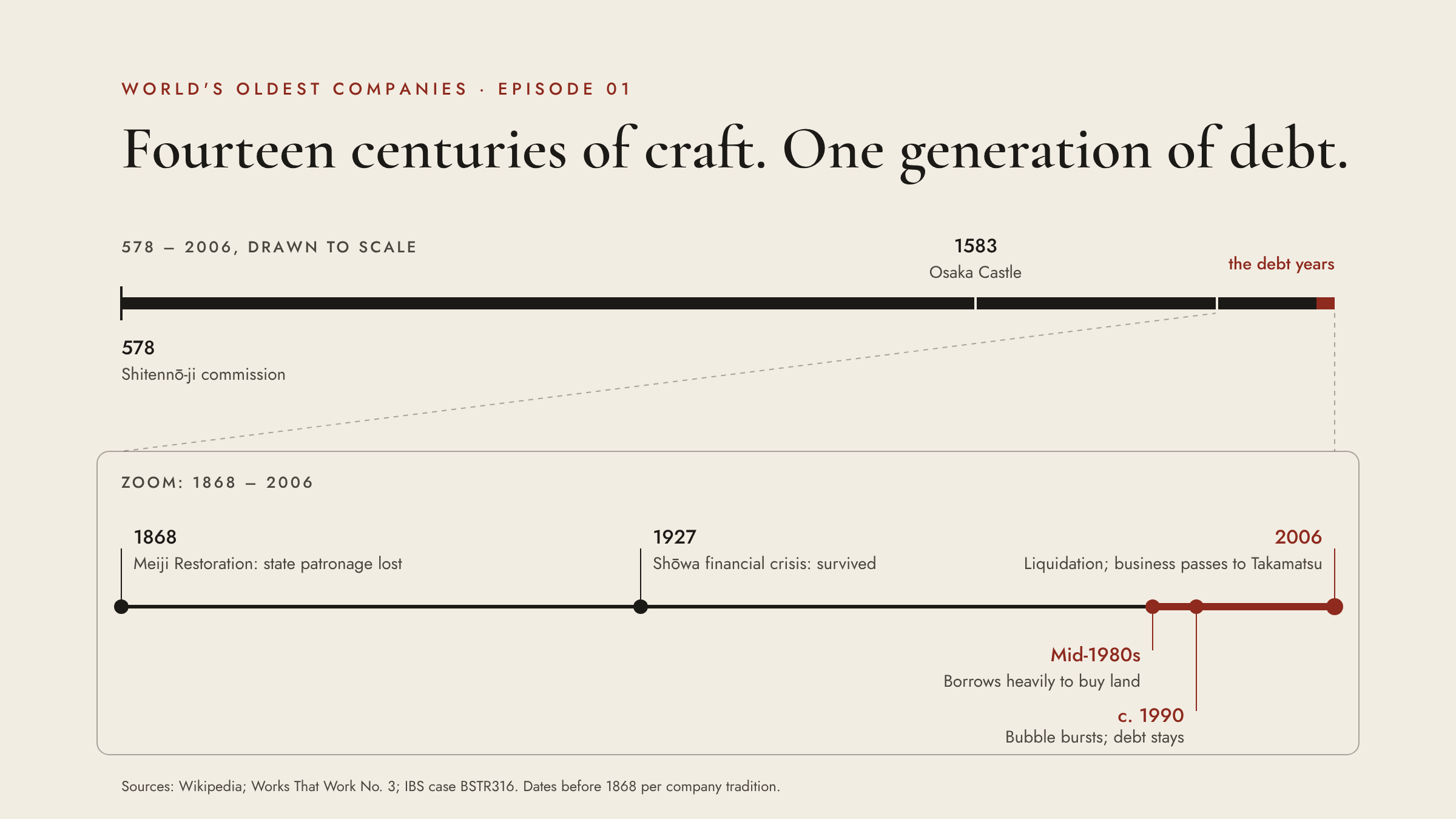
Shitennō-ji burned, fell and was rebuilt many times across the centuries. Each rebuild came back to the Kongō family. So did work on Hōryū-ji, the Kōyasan complex and, in 1583, Osaka Castle.
The business model was simple. Temples are permanent clients. They need maintenance forever, and disasters keep resetting the order book.
How It Lasted
Three habits kept the firm alive across roughly 40 generations.
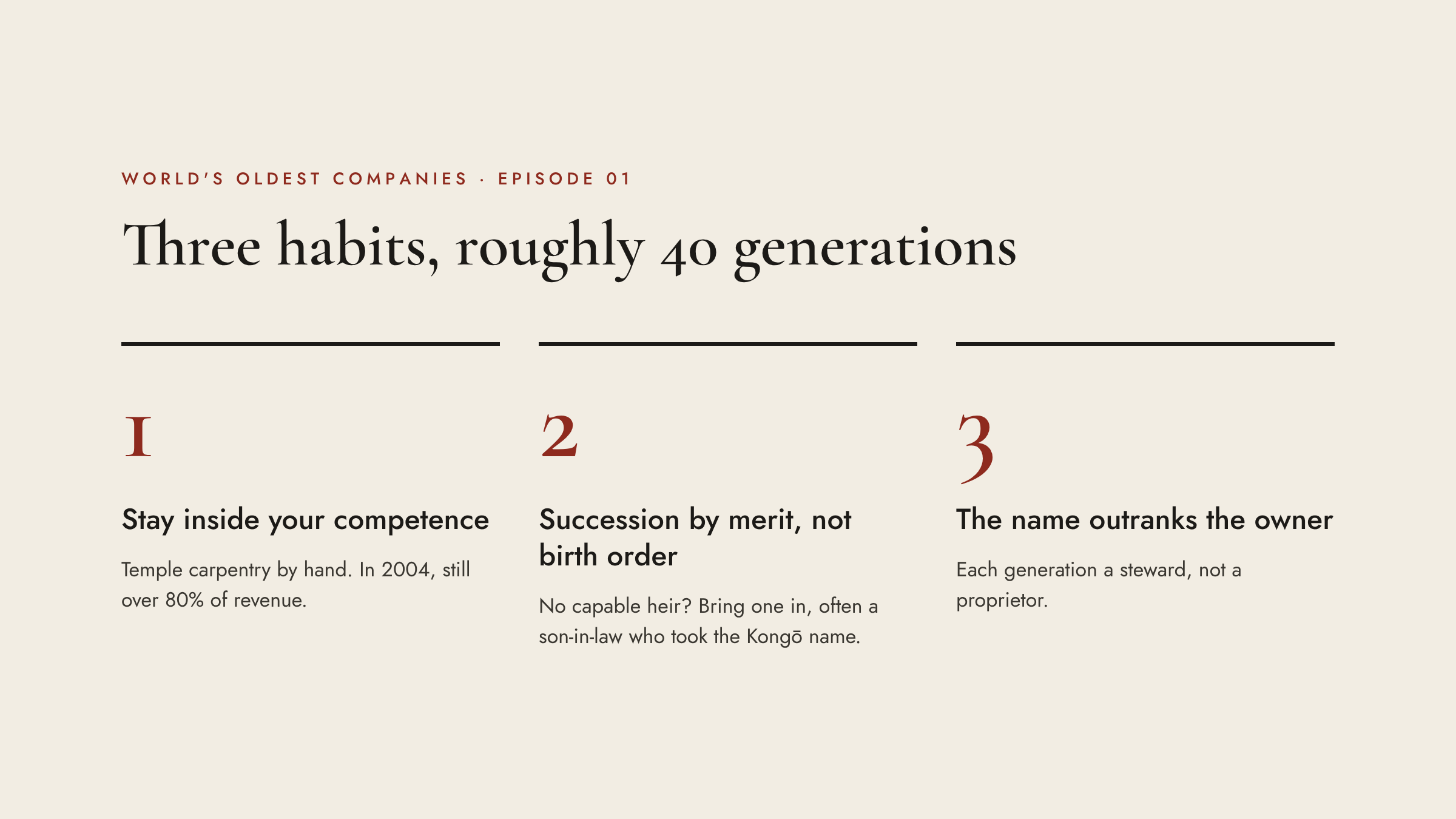
1. It stayed inside its competence. Temple and shrine carpentry, done by hand, with techniques handed down from the founding. As late as 2004, temple work still made up more than 80% of revenue.
2. Succession went to merit, not birth order. The eldest son did not inherit by right. When a capable heir was missing, the family brought one in, often a son-in-law who took the Kongō name. At one point the firm was rebuilt under Yoshie Kongō, its first woman head carpenter.
3. The name mattered more than any one owner. The family creed placed preserving the Kongō name above everything else. Each generation saw itself as a steward, not a proprietor.
Those habits carried the firm through the loss of state patronage after the Meiji Restoration and through the Shōwa financial crisis of 1927.
How It Fell
In the 1980s, Japan was in the grip of an asset bubble. Land prices soared and banks lent freely.
Under its 40th leader, Masakazu Kongō, the firm borrowed heavily to buy land and diversify into condominiums, hospitals and hotels. For the first time in fourteen centuries, it stepped well outside what it knew, and did so on borrowed money.
The bubble burst around 1990. The land lost value; the loans did not. Meanwhile demand for temple building was falling and concrete construction let larger rivals into the trade.
The firm carried those debts for more than a decade. Revenue in the early 2000s was still around $65–70 million, but servicing the borrowing became impossible. In 2004 it cut staff and budgets.
In November 2005, Takamatsu Construction set up a new company to take over the business. In January 2006 the operations and most employees moved across, and the old Kongō Gumi went into liquidation to settle with creditors. The name and the craft survive today as a Takamatsu subsidiary.
The Lesson
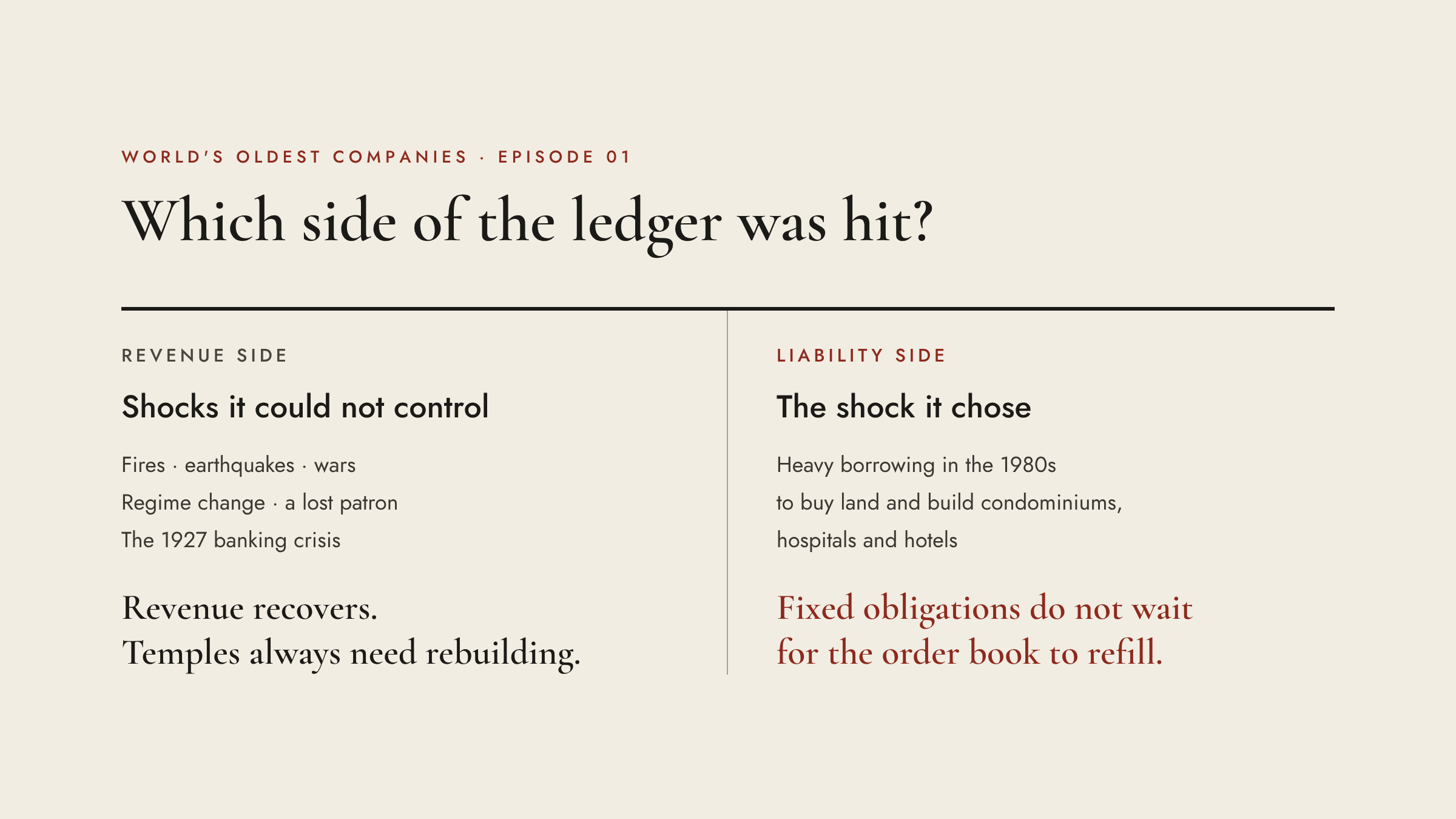
Kongō Gumi survived fourteen centuries of shocks it could not control: fires, earthquakes, wars, regime change, a lost patron and a banking crisis. It did not survive one it chose.
Most earlier crises threatened mainly the revenue side. Revenue recovers; temples always need rebuilding. The 1980s decision changed the liability side, and fixed obligations do not wait for the order book to refill.
The generations before were not smarter. They were constrained. A craft business funded by its own earnings cannot over-reach far. Cheap credit removed that constraint, and the firm's oldest discipline went with it.
"When a durable business takes on debt to do something it has never done, what exactly is the collateral?"
For anyone who reads accounts for a living, that is the question this story raises. Here, the collateral turned out to be 1,428 years.
Longevity is rarely an accident. But it can be undone by a single decision taken in good times.
That is the thread this series will follow: what kept the world's oldest companies alive, and what the near-misses reveal.
— Mahesh Ramanujam, FCA, DISA(ICAI) · R. Mahesh & Associates, Chennai
- Kongō Gumi — Wikipedia (founding, 2005–06 transfer to Takamatsu Construction, current status)
- Works That Work, No. 3 — Kongō Gumi (temple commissions, family creed, Shōwa crisis)
- IBS Case Development Centre — case BSTR316 (1980s land borrowing and diversification)
- Peter Fisk — Kongo Gumi (revenue mix and size in the early 2000s)
- Japanese Online — The Oldest Company in the World (the Baekje craftsmen and Prince Shōtoku)
The 578 AD founding date and the 1,428-year span rest on company tradition and are widely cited rather than independently documented.