| Business | Nishiyama Onsen Keiunkan — a hot-spring inn (ryokan) in Hayakawa, Yamanashi, recognised by Guinness World Records since 2011 as the world's oldest hotel |
| Founded | 705 AD by the inn's tradition, when Fujiwara no Mahito is said to have found the spring and built the first bath |
| Family-run for | Reportedly 52 generations, including adopted heirs, until 2017 |
| The test | A costly 2005 upgrade, sales down about 40% between 2000 and 2016, and no family successor to take over |
| Today | Run since June 2017 by a newly established company under Kenjiro Kawano, its first president from outside the founding family. The old operating company resolved to dissolve in 2018 and entered special liquidation in January 2019. |
The Hook
In 2006, a Japanese company that had survived for 1,428 years was undone by debt. That was Episode 01.
A year earlier, a hot-spring inn in the mountains of Yamanashi reached its 1,300th year.
No global brand. No famous founder. Just hot water from the ground, rooms for travellers, and a business that kept opening its doors in the same valley.
It still does. But almost everything around that water has changed. The buildings are modern. The baths are new. The family that ran it for thirteen centuries no longer does. Even the company that operates it is not the one it had in 2016.
So here is the question this episode asks: how do you keep a business alive for 1,300 years without turning it into a museum?
The Founding
By tradition, the story begins in 705, the second year of the Keiun era. Fujiwara no Mahito, the son of a court aide, is said to have found hot water rising from the riverbank while hunting. He cut a path up the steep valley and built a bath. The inn takes its name from the era: Keiun.
The spring is the foundation of the business. Everything else exists to make it valuable to guests. Over the centuries the inn drew warlords as well as travellers. Takeda Shingen and Tokugawa Ieyasu are both said to have bathed there.
One detail says a lot about how quietly the place ran. Until 2011, the Guinness title for the world's oldest hotel belonged to another Japanese inn, Hōshi, founded in 718. Keiunkan was older. It had simply never applied.
Japan's credit bureau Tokyo Shoko Research ranks it as the country's third-oldest business, behind Kongō Gumi and the Ikenobō school of flower arrangement.
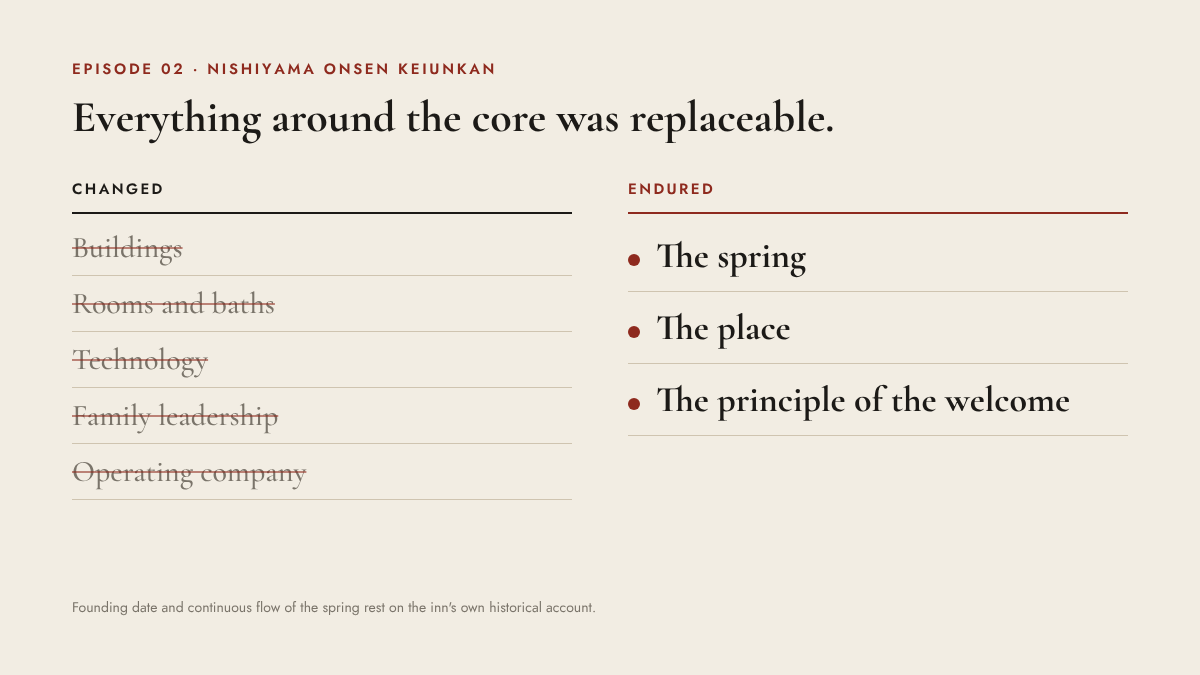
What Changed
The romantic version of this story says the inn survived because it never changed. The record says the opposite.
The buildings changed. The facilities guests see today are only a few decades old. Published accounts date the inn's present form, with private rooms, futons and half board, to 1997.
The product changed. In 2005, its 1,300th year, the inn gave every room its own open-air bath fed by free-flowing spring water, and drilled a new source to mark the anniversary. Today the rooms have Wi-Fi.
The leadership changed. In 2017 no family successor took over. The general manager, Kenjiro Kawano, became president, the first from outside the founding family. Sources count 52 generations of the family as heads of the inn; Kawano, as the next head, is described as the 53rd.
The operating company changed. In June 2017 the inn business was transferred to a newly established company. The old operating company was later renamed, its shareholders resolved to dissolve it in June 2018, and in January 2019 the Tokyo District Court ordered its special liquidation.
What Endured
Strip away the buildings, the baths, the family and the operating company, and what remains is short.
1. The spring. According to the inn's historical account, the spring has continued to flow since its founding. Today it rises on its own at about 52°C, and the inn uses it unheated and unmixed for its baths, its taps and even the heating of the building. There is no boiler.
2. The place. The water cannot be moved, so neither can the business. The location is the product, and it cannot be copied.
3. A principle of hospitality. We cannot prove that the welcome guests receive today is the welcome of the eighth century. What the record does show is a stated intent: when Kawano argued for changes after taking over, his case to his predecessor was that the inn could add new attractions without giving up what made it good.
That is the distinction. Everything around the core was treated as replaceable. The core was not.
The Ledger
Now read it the way an accountant would. Keiunkan's age is not proof that its finances were strong. They were not.
| Year | What happened |
|---|---|
| FY 2000 | Sales of about ¥996 million |
| 2005 | Private open-air baths in every room; new spring source drilled |
| 2005–2016 | Weak consumer spending and price competition keep sales flat; Tokyo Shoko Research reports that the cost of the earlier investment weighed on profit |
| FY 2016 | Sales of about ¥596 million, roughly 40% below 2000; the company slips into a loss |
| Jun 2017 | Inn business transferred to a newly established company; external president appointed |
| Jun 2018 | Shareholders of the old operating company resolve to dissolve it |
| Jan 2019 | Tokyo District Court orders special liquidation of the old operating company |
Look at that sequence and it rhymes with Kongō Gumi. A centuries-old business, a heavy investment, falling demand, and in the end the business moved into a new company while the old one was wound up.
But the investments differ. Kongō Gumi borrowed in the 1980s to buy land and diversify into condominiums, hospitals and hotels, outside its craft. Keiunkan spent on its own core: more hot water and better baths, the thing guests actually came for.
That does not make the spending sound. Keiunkan's problem was not necessarily investing in the wrong business. Its sales were falling, cheaper rivals were competing on price, and, as Tokyo Shoko Research reported, the cost of the earlier investment weighed on profit. Together they left a company carrying more than its revenue could comfortably support. An investment can strengthen the product and still weaken the company that finances it.
The old operating company did not survive. The inn business did, transferred to a newly established company with a new leader and guests to serve.
The Lesson
Accounts are prepared for an entity. Longevity belongs to a business. Most of the time those are the same thing, so nobody notices the difference. Keiunkan shows what happens when they come apart.
A business that wants to last has to treat almost everything as negotiable: its buildings, its technology, its ownership, even its legal form. What it cannot negotiate is the one thing that, if lost, would leave nothing worth carrying forward.
It would be easy to credit tradition for Keiunkan's survival. The evidence suggests a more complicated story. The inn continued to adapt, made an expensive investment that coincided with a prolonged decline in sales, and ultimately transferred its operations to a new company. Its history is not proof that preserving the core guarantees survival. It shows why a viable business, a sustainable capital structure and a continuing legal entity must be examined separately.
"If your company had to be wound up tomorrow, what would be left that someone would want to carry forward?"
A business can invest in the right thing, for the right reason, and still invest more than it can afford.
— Mahesh Ramanujam, FCA, DISA(ICAI) · R. Mahesh & Associates, Chennai
- Tokyo Shoko Research (2018) — sales FY2000 and FY2016, 2005 investment, June 2017 transfer, dissolution resolution, 53rd head (Japanese)
- JC-Net (Jan 2019) — special liquidation by Tokyo District Court (Japanese)
- SoraNews24 (Jan 2019) — liquidation and causes in English
- Yamanashi Tourism Organisation — Keiunkan — spring temperature, self-flowing source, unheated use and no boiler (Japanese)
- 慶雲館 — Japanese Wikipedia — founding legend, Guinness 2011 and Hōshi
- Nishiyama Onsen Keiunkan — Wikipedia — 52 generations, 1997 format
- Episode 01 — Kongō Gumi — the 1980s borrowing and diversification, sourced there to the IBS Case Development Centre (BSTR316) and Wikipedia
- Daido Life — feature on president Kenjiro Kawano — first non-family president; what to keep and what to change (Japanese)
The 705 AD founding date, the 52-generation lineage and the spring's continuous flow rest on the inn's own historical account and are widely cited rather than independently documented.